Nelexus PMed me :
Hi Ultima, I have
a few Chemistry questions that I would like to clarify with you. Am
a graduated JC student but intending to read chemistry in uni. So I
have been reading up on Chemistry before Uni starts. Some of the
questions I am asking will be covering advance concepts far beyond
the h2 chem syllabus.
1. Resonance Vs
Conjugation
What is the
difference between resonance and conjugation? From what I've read
online, a continuous overlapping of adjacent p orbitals forms a
conjugated system. The overlapping of p orbitals allows electrons
to "move" in the conjugated system, resulting in delocalisation of
electrons in that conjugated system. This is illustrated by the
diagram below I've picked up from the internet.
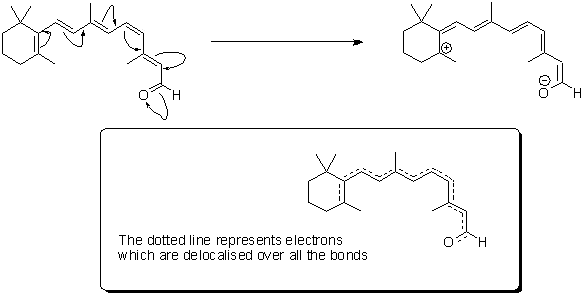
Therefore, from this
scenario above, conjugation allows resonance to
occur.
Now consider the
conjugate base of benzoic acid and pyruvic acid. I believe they are
all conjugated system. The thing is, for the benzoate ion, the
electrons on oxygen in the carboxyl group cannot be delocalised
into the benzene ring no matter how I draw, thus no resonance
structure forms arises for the benzoate ion. Likewise for the
pyruvic acid, the electrons cannot be delocalised into the ketone
group. So while they are conjugated, there are no resonance
structure for . This sounds abit strange, considering that for a
conjugated system with p orbitals overlapping with each other,
electrons can "move" around the system, yet this is not possible
for the electrons on the oxygen atoms of benzoate and pyruvate ion.
My point is ilustrated below (pardon the big image)

For this
amine below that I've drawn, there's a conjugated system and the
delocalisation of electrons can happen. My confusion is tha
tlogically, conjugation which is the overlapping of p
orbitals, should allow electrons to delocalise, and thus entails
resonance. Yet this is not the case for some system.
Why?

2. pH of equivalenve
points of polyprotic acids
The diagram below
shows the titration curve of sulfurous acid with sodium
hyroxide.

For he second
equivalence point where only SO3 2- is present, the equivalence
point can simply be obtained by obtaining the Kb of SO3 2-, and
then find [OH-] using Kb = [OH-]^2/ [SO3 2-] am I right?
Now the tricky part
is the first equivalence point. The species present in the first
equivalence point is HSO3- which is an amphoteric species. Meaning
HSO3- can act both as a base and an acid as follow
HSO3 - + H2O
--> SO3 2- + H3O+ Ka
HSO3 - + H2O --> H2SO3 + OH- Kb
Is it possible to
calculate the pH of the first equivalence point?
I understand that for
amino acids, theres this formula pH = 1/2 (pka1+pka2) which is used
for calculating the pI and the so called equivalence point as shown
below.

Logically amino acids
are polyprotic acids as well, so would the same formula work? Or do
I have to physically inspect whether Ka or Kb is larger, and then
proceed to using the method I used for finding the second equiv
point?
3. Amino
Acids
For amino acids, why
is it that amino acids always exist in its protonated form? For
example, in the titration of amino acids, the major species in the
beginning is always NH3+ -R - COOH at a low pH. Should it be the
case that say in the laboratory, the amino acids you work with are
powders in the form of zwitterions NH3+ - COO- and then when you
add it into water, the carboxylate group gets protonated and a
basic solution is formed. Yet this is not the case
for the examples I've seen on the internet, where the amino acids
exist as NH3+ - R - COOH at pH < 7?
Secondly, to say the
isoelectronic point of an amino acids, does it mean to have equal
concentrations of both the cation and anion, or the maximum
concentration of the zwitterions? Some textbooks obtain the formula
of pH = 1/2 (pka1+pka2) using the assumption that [cation] =
[anion], which I think does not make sense.
I quote from
Essentials of Organic Chemistry by Dewick
"The pH at which the
concentration of the zwitterion is a maximum is equal to the
isoelectric point pI, strictly that pH at which the
concentrations of cationic and anionic forms of the amino acid
are equal. With a simple amino acid, this is the mean of the
two pKa.

in the derivation, how is the statement " cation = anion " true?
Doesn't the dissociation of amino acids occur stepwise, meaning
cation --> pka1 where cation = zwitterion --> equivalence
where only zwitterion --> pka2 where zwitterion = anion -->
2nd equivalence where there is only anion.
I understand that these questions are far beyond the h2 chem
syallbus which you may not be obliged to answer, but I really hope
you do. I've scoured countless materials and resources on the
internet to find no answer. Thank you in advance!